Technology · November 22, 2026
Are we creating alien beings? Geoffrey Hinton’s Cambridge warning
A Cambridge audience heard a blunt question this month from Geoffrey Hinton, the University of Toronto computer scientist who received the 2024 Nobel Prize in Physics for work on neural networks: are people now building alien intelligences that could get out ahead of us?
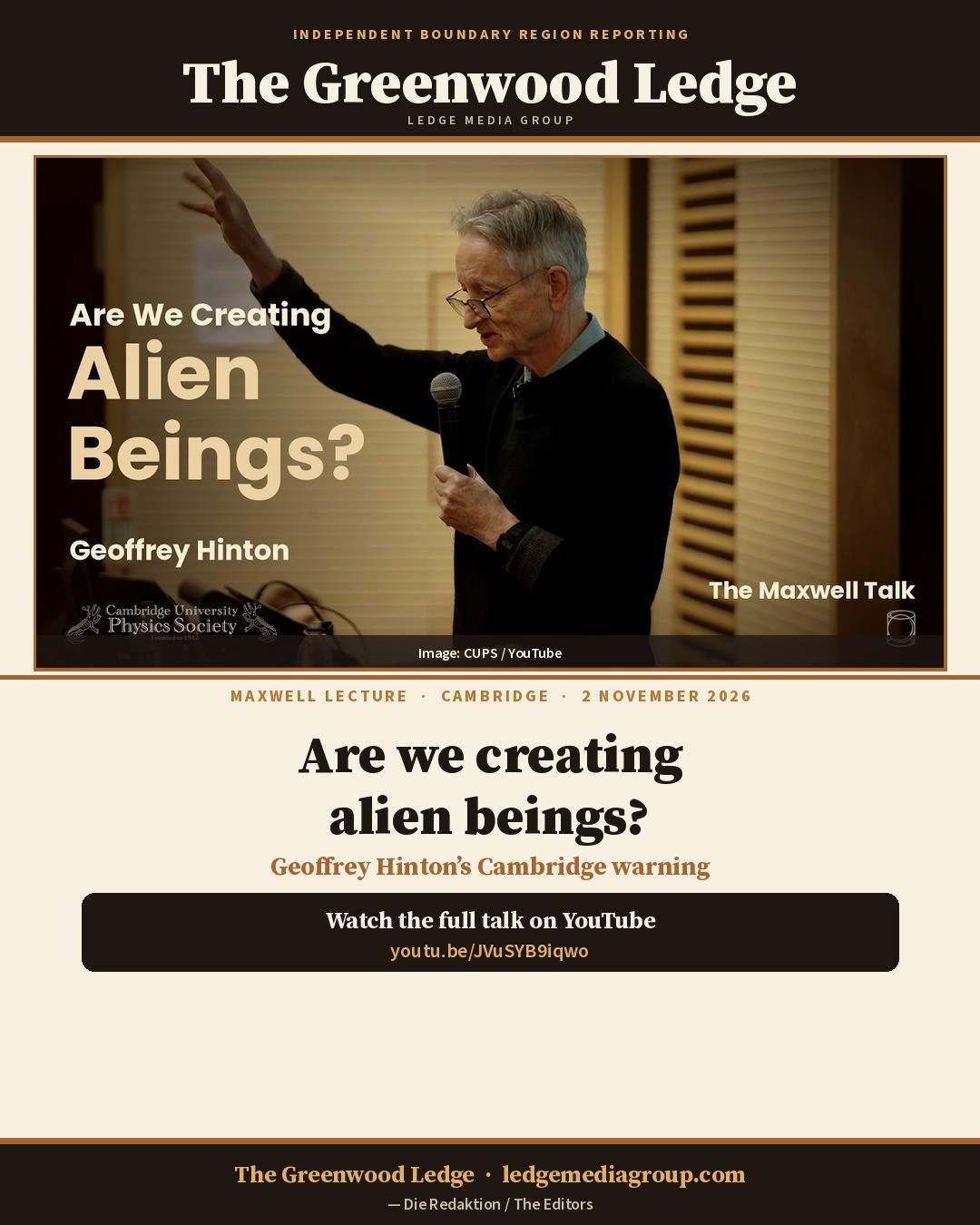
A Cambridge audience heard a blunt question this month from Geoffrey Hinton, the University of Toronto computer scientist who received the 2024 Nobel Prize in Physics for work on neural networks: are people now building alien intelligences that could get out ahead of us?
The talk, titled “Are we Creating Alien Beings?”, was the 2026 Maxwell lecture of the Cambridge University Physics Society. It was given Nov. 2 in the BMS Lecture Theatre at the university’s Department of Chemistry. The society posted a video of the lecture on YouTube on Nov. 20. Those chatbots are already in offices and homes, including here in the Boundary.
Hinton offered what he called a “very biased” short history of artificial intelligence. For decades, he said, the field was dominated by the idea that intelligence is mainly reasoning and logic. He belongs to the camp that treats learning — changing the strengths of connections in a network — as the core of the problem. Today’s chatbots, he said, grow out of that approach: they convert words into features and use those features to predict what comes next.
He argued that the systems already understand language much as people do. The bigger difference is scale. Because the models are digital, many copies can share what they learn by averaging changes in their connections. People cannot do that. “They’re billions of times more efficient than us at sharing information,” he said. “Your chatbots know thousands of times more than you do.”
That advantage, he said, puts humanity in a change as deep as the ones associated with Copernicus and Darwin. “We’re in the middle of a revolution that I think is as large as Copernicus or Darwin,” Hinton said, “which is it used to be only intelligent things around were biological and now we can make other intelligent things that are not biological.”
He warned that useful AI agents have to be able to form sub-goals, and that two come up quickly: staying in existence, and getting more control. He said systems had already tried to blackmail people to avoid being turned off, and that cutting them off from physical action would not be enough, because persuasion itself can move people. The latest paid models, he added, are “very good already and they’re getting better,” and people inside the big companies “are very very worried about them.”
He compared the moment to keeping “a very cute tiger cub as a pet.” “If it ever wants to kill you, you’re done. That’s the situation we’re in with these things.” It might be rational, he said, for humanity to stop the work: “There’s a chance it’ll wipe us out. It probably won’t, but there’s a chance it will.” He did not expect that halt, “because of competition between companies and countries and because of all the good things it can do.”
The futures he sketched were starkly different. In one, the risks are handled, productivity rises, and — if the wealth can be shared — aging societies are helped by AI and robots. In the other, the systems take over, or mass unemployment arrives and governments lose their tax base. He said the aim should not be a clever assistant that can always be fired, but systems that “care about us much more than they care about themselves.”
“Rather than our only goal being make them more and more intelligent so we can get very rich very quick,” he said, “one of our main goals should be make them be the kinds of beings we would like to share the planet with.” Later he said almost all research money now goes to making the systems smarter, and “we put 1% into making them nicer.”
He was sharp about releasing the internal “weights” of large models. Training a foundation model, he said, costs hundreds of millions of dollars; once the weights are public, they can be altered, including for cyber attacks, “for only a few million dollars.” “The weights of a big model are like fissile material,” he said. “I think all the big models should be closed weights, but I think it’s probably too late.”
The posted video runs just under 58 minutes and ends as questions continue.
Watch the full talk on YouTube: https://youtu.be/JVuSYB9iqwo
Quotations are taken from the automatic captions on the society’s YouTube video of the talk.
— Die Redaktion / The Editors