Finance Desk · July 28, 2026 · Japan / global liquidity
Japan’s money stress test: yen, debt, carry trade and the global money supply
A viral YouTube finance video argues that Japan is forcing its money home and that the result could shake U.S. bonds, stocks, Bitcoin and the global money supply. The dramatic version needs caution. But the underlying issue is real: Japan has been one of the world’s largest sources of cheap funding. If the yen stops being free money, global liquidity gets tighter even if no central bank formally “shrinks M2.”
Executive summary
- What is verified: the yen is historically weak; Japanese long-term yields have risen; Japan’s public debt remains above 200% of GDP; the Bank of Japan’s balance sheet is enormous; and Japan remains a major foreign holder of U.S. Treasuries.
- What is plausible: higher Japanese yields make home-country bonds more attractive for insurers, pensions and banks that previously bought foreign bonds for yield. Even partial repatriation can pressure foreign bond markets and risk assets.
- What is not proven: anonymous social-media claims about an official command to pull “Japan’s wealth” home, or claims that Article 589 is a new universal weapon against foreign borrowers.
- Money-supply effect: this is less about mechanically deleting dollars from bank accounts and more about tightening global credit conditions: fewer yen-funded trades, less demand for foreign bonds, higher term premiums, and a more fragile dollar-funding backdrop.
The video claim in plain English
The video’s core argument is that Japan exported cheap money for decades. Investors borrowed yen near zero, converted it into dollars or other currencies, and bought higher-yielding assets: U.S. Treasuries, U.S. stocks, credit, emerging-market assets, crypto and other risk trades. That is the simple version of the yen carry trade.
When Japanese rates were pinned near zero and the yen was stable or weakening, the trade looked easy. But if Japanese yields rise, the yen strengthens, or Japanese institutions start preferring domestic bonds again, the math changes. Borrowed yen must be bought back. Foreign assets may be sold. That can create a liquidity squeeze that looks global even though the trigger is domestic Japanese policy.
The video mixes strong data points with speculative ones. This article separates the source-backed mechanics from the viral parts.
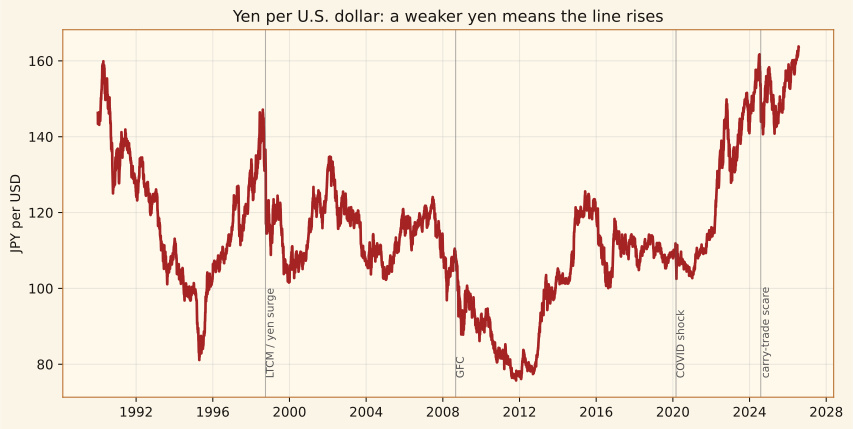
Why Japan matters to people nowhere near Tokyo
Japan is not simply another country with a weak currency. It is a major creditor nation, a large holder of foreign securities, a long-time buyer of U.S. government debt, and home to institutions that manage huge pools of savings. The video is right to focus on Japan’s international balance-sheet role, because Japan’s domestic interest-rate shift can be exported through portfolios.
As of the latest U.S. Treasury TIC table checked for this article, Japan held about $1,143.1 billion of U.S. Treasury securities in 2026-05. China held about $659.3 billion, and the United Kingdom held about $948.6 billion. Those numbers move month to month, but the message is durable: Japan is a top-tier buyer and holder of U.S. government debt.
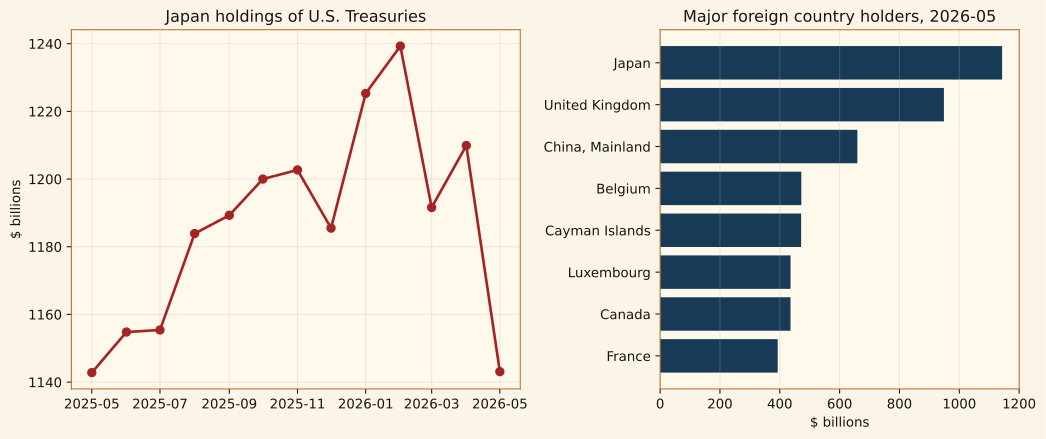
| Holder | 2026-05 holdings, $ billions |
|---|---|
| Japan | 1,143.1 |
| United Kingdom | 948.6 |
| China, Mainland | 659.3 |
| Belgium | 472.0 |
| Cayman Islands | 471.3 |
| Luxembourg | 436.0 |
| Canada | 435.8 |
| France | 393.1 |
The domestic pressure: debt, yields and the BOJ balance sheet
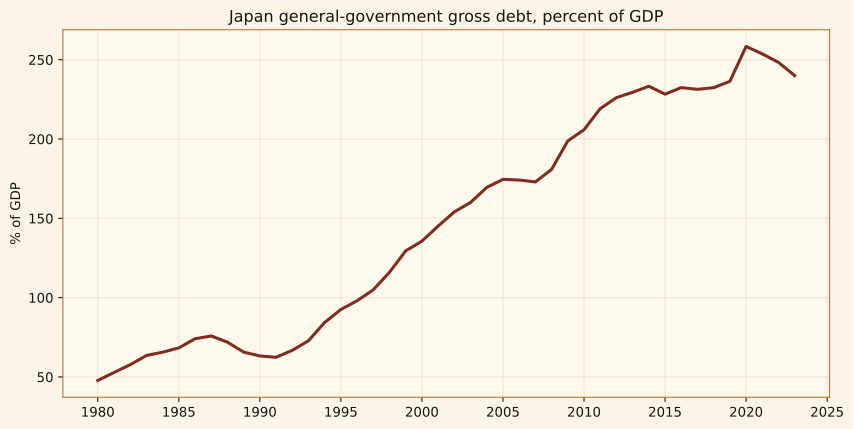
Japan’s public-debt story is the part everyone knows but often misunderstands. A high debt-to-GDP ratio does not automatically cause default if the debt is mostly domestic, the central bank can buy bonds, inflation is contained, and local savers keep financing the state. Japan proved that for decades. The problem is that the cost of that arrangement rises when inflation and yields return.
FRED’s IMF-backed gross-debt series puts Japan’s general-government gross debt at 240.0% of GDP in 2023. FRED’s 10-year Japanese government-bond yield series shows the benchmark yield at about 2.67% in June 2026. Those yields are still low compared with many countries, but they are high by recent Japanese standards.
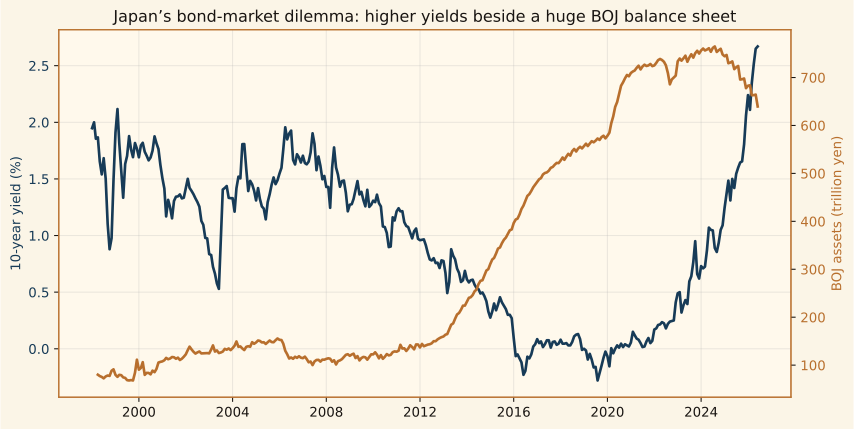
The Bank of Japan’s large balance sheet matters because it helped suppress yields and stabilize the JGB market. But a central bank cannot solve every problem at once. If it buys too many bonds to hold yields down, it may weaken the currency. If it allows yields to rise to defend the currency and normalize policy, it raises the financing cost of a heavily indebted government and changes the return calculus for every Japanese institution that owns bonds.
The carry trade is a global money-supply story — but not in the cartoon way
The phrase “global money supply” can mislead. Official money supply measures such as M2 count bank deposits and similar liquid money inside a currency area. A hedge fund selling U.S. stocks to buy back yen does not automatically erase U.S. M2. A Japanese insurer selling Treasuries and buying JGBs does not by itself delete dollars from existence.
But global liquidity is broader than M2. It includes the willingness of banks, funds, insurers and pensions to lend, borrow, hedge and hold risk. The yen carry trade created a shadow form of global liquidity because cheap yen funding made it easier to own higher-yielding foreign assets. When that reverses, the effect can feel like a money-supply contraction:
- yen borrowers must buy yen back, which can strengthen the yen quickly;
- foreign assets used in carry trades can be sold to reduce leverage;
- fewer foreign buyers for U.S. Treasuries can push yields higher unless another buyer steps in;
- higher yields raise mortgage, corporate and government borrowing costs;
- risk assets can fall as leverage comes down; and
- central banks may be forced to choose between inflation, currency stability, financial stability and debt-service costs.
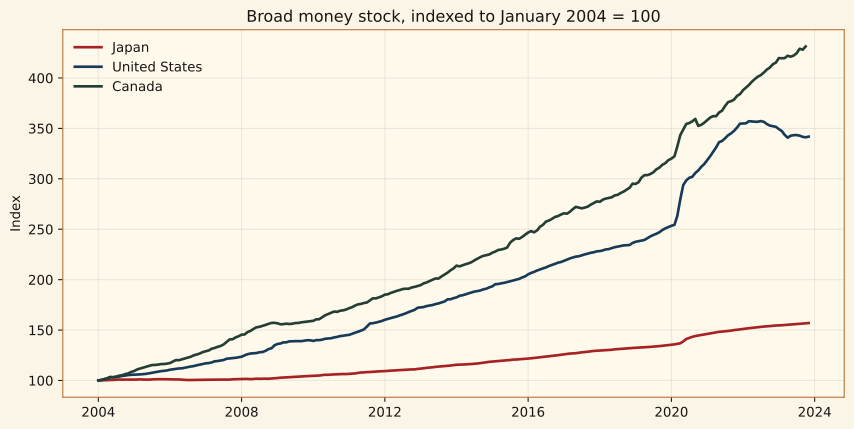
Using the OECD/FRED broad-money series from January 2004 to the latest common 2023 data in this pull, Japan’s broad money rose by roughly 57%, the United States by roughly 242%, and Canada by roughly 331%. That supports the video’s broad direction — Japan’s money stock grew much less than North America’s — while reminding readers that the exact percentages depend on the money aggregate and date range.
How repatriation would transmit through markets
Imagine a Japanese insurer that for years bought U.S. bonds because JGBs yielded almost nothing. That foreign bond created currency risk: the insurer earned dollars but ultimately owes yen liabilities. If JGB yields rise enough, the insurer can ask a simple question: why own a hedged U.S. bond if a domestic JGB now pays a tolerable yield in the same currency as our liabilities?
That is the repatriation channel. It does not require a secret order. It can happen because incentives changed. The same logic applies to banks, pension funds, life insurers, households and corporations that built portfolios during the zero-yield era.
The global effect depends on scale and speed. A slow rebalancing is manageable. A fast unwind is dangerous because carry trades are reflexive: a stronger yen forces more buying of yen, which strengthens the yen more, which forces more deleveraging.
What about the viral “Article 589” claim?
The video discusses anonymous posts warning that “Article 589” will be used against foreign borrowers. Ledge could not verify the anonymous-source claim as an official Bank of Japan or Japanese government policy. The public Japanese Law Translation database identifies Civil Code Article 589 as “Interest” under loans for consumption. Its English translation says that, absent a special agreement, the lender may not demand interest from the borrower, and where such an agreement exists, interest can accrue from the day the borrower receives the money or thing.
That is contract-law language. It may be relevant to loan terms, but it is not, by itself, proof of a new global monetary-control mechanism. The responsible way to treat the viral claim is: unverified social-media interpretation; official law text does not support the more dramatic reading on its own.
Stablecoins, yen funding and digital money
The video also points to Japanese stablecoin regulation. That part belongs in the conversation, but carefully. Japan has been building legal rails for stablecoins and electronic payment instruments. Stablecoin policy can matter for cross-border settlement, digital bank deposits and yen-denominated payment systems, but it does not prove a plan to force a global repatriation of capital.
The better interpretation is strategic: if currencies become more digital and settlement moves faster, countries with large savings pools will care more about who controls rails, reserves and redemption. Japan’s stablecoin framework is part of that larger global competition over payment infrastructure.
Scenarios for global money and local households
Scenario 1: Slow normalization
Japan allows rates to rise gradually, the yen stabilizes, Japanese institutions rebalance slowly, and global markets absorb the shift. U.S. yields may stay higher than they otherwise would, but there is no sudden liquidity shock. This is the soft-landing version.
Scenario 2: Disorderly yen rally
The yen strengthens sharply because investors rush to cover yen liabilities. Carry trades unwind. Foreign bonds and risk assets sell off. This is the scenario market veterans worry about because it can happen quickly and globally.
Scenario 3: BOJ forced back into heavy support
If yields rise too fast, the BOJ may be pressured to buy more JGBs or slow normalization. That can calm domestic bonds but risk a weaker yen, imported inflation and renewed currency-market pressure.
Scenario 4: U.S. absorbs the flow with higher yields
If Japan buys fewer Treasuries or sells some holdings, the U.S. can still fund itself — but perhaps at higher yields. Higher Treasury yields feed into mortgages, business loans, equity valuations and government interest expense. That is how a Japanese portfolio shift reaches a Canadian or Boundary-region household: through rates, investment returns and the cost of capital.
Bottom line
The dramatic claim that “Japan’s money is collapsing” is too simple. Japan is not Argentina, and it still has major strengths: domestic savings, deep institutions, a large net international investment position and a central bank with credibility built over decades. But the old model — zero rates, weak yen, overseas search for yield and huge JGB purchases — is under stress.
The real issue is not whether one viral account is right. It is whether the global financial system has become used to Japanese savings acting as cheap background funding. If that funding becomes more expensive or returns home, global liquidity tightens. That can affect the money supply indirectly by changing credit creation, asset prices, government borrowing costs and central-bank choices.
For readers, the practical takeaway is not panic. It is to watch five numbers: the yen, 10-year JGB yields, BOJ asset purchases, Japan’s Treasury holdings and U.S. long-term yields. Together they tell us whether this is a slow normalization story or the start of another global carry-trade unwind.
Sources checked
- Andrei Jikh — Japan’s Money Is Collapsing / Japan Is Starting To Break
- FRED — Japanese Yen to U.S. Dollar Spot Exchange Rate (DEXJPUS)
- FRED — Long-Term Government Bond Yields: 10-year Japan
- FRED — Bank of Japan total assets
- FRED / IMF — Japan general government gross debt as % of GDP
- FRED / OECD — Japan broad money; U.S. broad money; Canada broad money
- U.S. Treasury TIC — Major foreign holders of Treasury securities, table 5
- Bank of Japan — monetary policy pages
- Japan Ministry of Finance — official reserve assets
- Japanese Law Translation — Civil Code Article 589